


What Factors Should Be Considered When Choosing a Vertical Slurry Pump in a Sewage Treatment Plant?
When choosing a vertical slurry pump in sewage treatment plants, they need to consider multiple factors in a comprehensive way to ensure that the pump can meet the needs of sewage treatment processes and achieve efficient, stable and economical operation. Here are the detailed considerations:
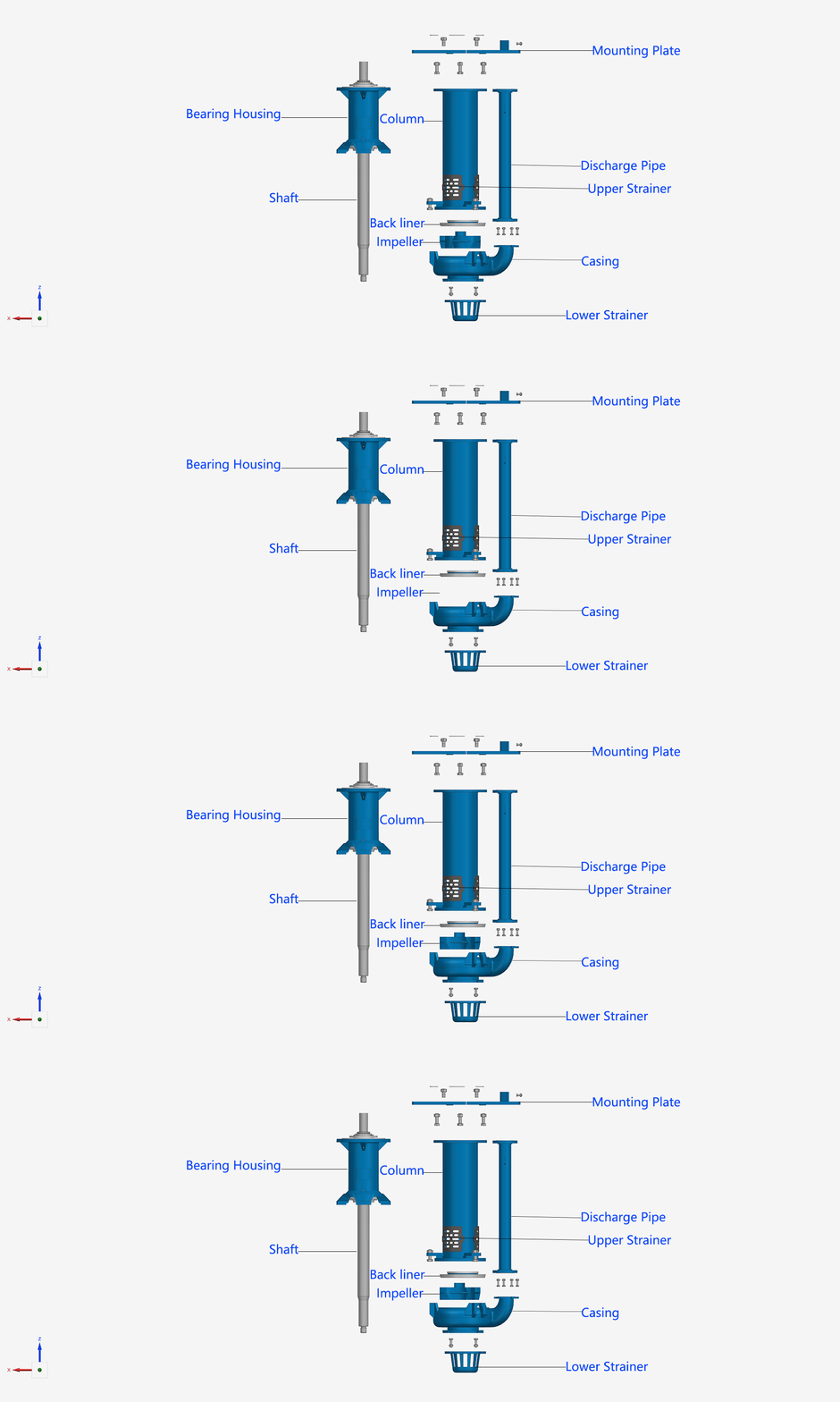
Media Characteristics
Ingredients and properties: Understand the types of impurities contained in sewage, such as whether they contain sediment, fiber, oil, chemical substances, etc. For sewage containing a large number of solid particles, a slurry pump with good wear resistance is necessary; for sewage containing corrosive substances, the material of the slurry pump must be considered to have corresponding corrosion resistance.
Particle size and concentration: Determine the size and concentration of solid particles in wastewater. Sewage with large particle size or high concentration will cause severe wear to the impeller and overflow components of the slurry pump. Therefore, it is necessary to choose a pump type with strong wear resistance and reasonably determine the flow rate and head of the pump according to the particle size and concentration.
Temperature and pH: The temperature and pH of the wastewater will affect the material selection of the slurry pump. High-temperature sewage may require the pump body and impeller to use high-temperature resistant materials; while acidic or alkaline sewage requires the material of the slurry pump to have good acid and alkali resistance.
Flow and head requirements
Flow: Accurately calculate the required sewage flow based on the scale and treatment process of the sewage treatment plant. Generally speaking, considering the maximum flow rate and average flow rate, the flow rate of the selected pump should be able to meet the maximum flow rate requirements, and at the same time have high efficiency when operating under the average flow rate conditions.
Head: Determine the height of sewage that needs to be lifted and the resistance loss of the pipeline system, thereby calculating the required head. When calculating the head, consider possible future process adjustments and pipeline transformations and appropriately reserve a certain amount of head margin.
Installation conditions
Space limitation: The site space of the sewage treatment plant may be limited, and it is necessary to choose a vertical slurry pump of the appropriate size according to the actual installation space. At the same time, the installation method and maintenance space of the slurry pump should be considered to ensure that the installation and maintenance of the pump can be carried out smoothly.
Level Change: The level of the sewage tank may change as the treatment process progresses, so it is necessary to choose a pump that can adapt to the level changes. If the liquid level fluctuates greatly, a vertical slurry pump with a long under-liquid depth can be selected.
Efficiency and energy consumption
Pump efficiency: The efficiency of the slurry pump directly affects the operating cost. Choosing a high-efficiency pump can reduce energy consumption and reduce operating costs. When selecting the model, you can refer to the pump efficiency curve and select a pump type with higher efficiency under the design flow rate and head.
Energy consumption analysis: In addition to the efficiency of the slurry pump, the power and energy consumption of the motor must also be considered. Choose a motor with the right power and avoid the situation of "big horse pulling a small cart" or "big horse pulling a big cart" to achieve energy-saving operation.
Our professional slurry pump team is always At your services.
Contact: Ms.Serena Zhang
Tel: +86 13333119820
Email: sales@cnsmepump.com
WhatsApp: +86 13333119820
Add: 260# West Huaian Road, Shijiazhuang, Hebei, China. 050051.